
Independent Financial Research & Analysis
Daily briefings, 7,600+ real-time charts, and macro insights from Dr. Ed Yardeni and his research team.
Research
Latest Research
Recent insights from our research team
Japan’s Difficult Return Back To Normal
The Bank of Japan is widely expected to raise its key interest rate by 25 basis points this week following June’s hike to 1.00%. William likens the surrounding circumstances to a minefield. With the economy fragile, the stakes of tightening too fast are high, warn the BOJ’s doves. But the US is exerting fierce pressure to tighten faster, buoying the yen, and the BOJ’s hawks want higher rates ASAP after the decades of ultra-low interest rates that have enervated Japan’s economy. … Also: Toby observes that analysts have been raising their earnings sights for Japanese companies even as investors have been devaluing Japanese stocks. It’s a market repricing risk, not earnings strength.
Warsh & Bessent Share A Credibility Problem
President Donald Trump has some advice for the Fed. Speaking to reporters at the Irish Open golf tournament today, he said he did not know whether Fed policymakers will raise interest rates at their meeting this week. But he said the US "should be paying the lowest interest rate in the world" even though economic growth is robust and inflation remains sticky above the Fed's 2.0% target. The President was a frequent critic of former Fed Chair Jay Powell. He has been more supportive of the new Fed Chair Kevin Warsh. But Trump recently made his demands clear. "LOWER THE RATE OR I'LL STOP TRADING WITH COUNTRIES WITH WHICH WE HAVE A DEFICIT," Trump posted on social media two weeks ago. Warsh is likely to displease Trump on Wednesday, when the FOMC is widely expected to hike the federal funds rate by 25bps to a range of 3.75%-4.00%. A couple of dissenters may emerge, but Warsh won't be one of them. Furthermore, he is likely to be quite hawkish during his press conference after the FOMC meeting on Wednesday. While he has foresworn providing any forward guidance, we expect that his comments will convince financial market participants that this may be the beginning of a rate-hiking cycle. That won't come as a surprise. The federal funds futures market is already anticipating three to four rate hikes over the next 12 months (chart). The same can be said for the two-year Treasury yield, which closely tracks the 12-month federal funds futures (chart). The Fed had a credibility problem before Warsh replaced Powell. The FOMC cut the federal funds rate (FFR) four times in late 2024 by a total of 100bps to ease financial conditions on concerns that the labor market might weaken. The bond market dissented, as the 10-year yield rose 100bps (chart). The FOMC cut the FFR three times by a total of 75bps in late 2025. The bond yield diverged again, rising to 5.00% intraday today. Now, Warsh owns the Fed's credibility problem. He has been talking hawkishly since June. Now, he has to deliver a rate hike. After all, he promised to follow the financial markets' lead. The 2-year and 10-year yields are clearly calling for a rate hike. If they keep rising after Warsh's presser on Wednesday, then he will still have a credibility problem. US Treasury Secretary Scott Bessent also has a credibility problem. In his early confirmation hearings and initial media rounds in January and February 2025, Bessent argued that the administration’s strategy of promoting "deregulation, energy dominance, and fiscal restraint" would naturally anchor long-term interest rates. He positioned a stabilizing 10-year yield as a direct vote of confidence in the new economic agenda. When yields tested key thresholds early in 2025, Bessent consistently pushed back against market narrative-spinning, arguing that short-term moves in the 10-year were often exaggerated by market participants. He stressed that the Treasury's primary focus was orderly debt management and predictable issuance schedules, not micromanaging daily yield ticks. Bessent recently described his role as the nation’s "top bond salesman" and said Treasury yields serve as a key economic barometer. As yields climbed—even amid Treasury interventions like targeted buyback operations—he took a confident, combative stance against skeptics, saying the US economy and its debt management were in "good shape." The backup in bond yields since Bessent propped up the yen at the end of July suggests that he needs to be a more persuasive bond salesman (chart). Then again, Bessent is also a bond issuer. If his goal is to keep the 10-year yield below 5.00%, as we believe, then he might have to significantly increase the Treasury's bond buybacks and finance them with more Treasury bills. Alternatively, after voting for a rate hike this week, as we expect, Warsh could rebuild the Fed's inflation-fighting credibility with a hawkish press conference. By backing his rhetoric with policy action, he might persuade financial markets to have more confidence in the Fed. That could reduce the burden on Bessent to bolster his credibility with the Bond Vigilantes.
Worry List Is Growing More Worrisome
We’re still strong believers in our Roaring 2020s scenario, hinging on a productivity boom that strengthens economic growth even as it contains inflation. However, we’ve shaved the subjective odds that we ascribe to that scenario from 80% to 70% and now see a 30% chance that rising geopolitical and other risks could derail it. Today, Ed and Elias update our deepened worry list, detailing the concerning prospects, as well as reiterate the reasons that we remain bullish. We still believe that strong earnings growth will lift the S&P 500 to our 8400 price target by year-end.
Archive
Our Research Library
19 years of daily research, charts, and analysis
Topics
QuickTakes Topics
Timely commentary covering the most important market themes
Charts
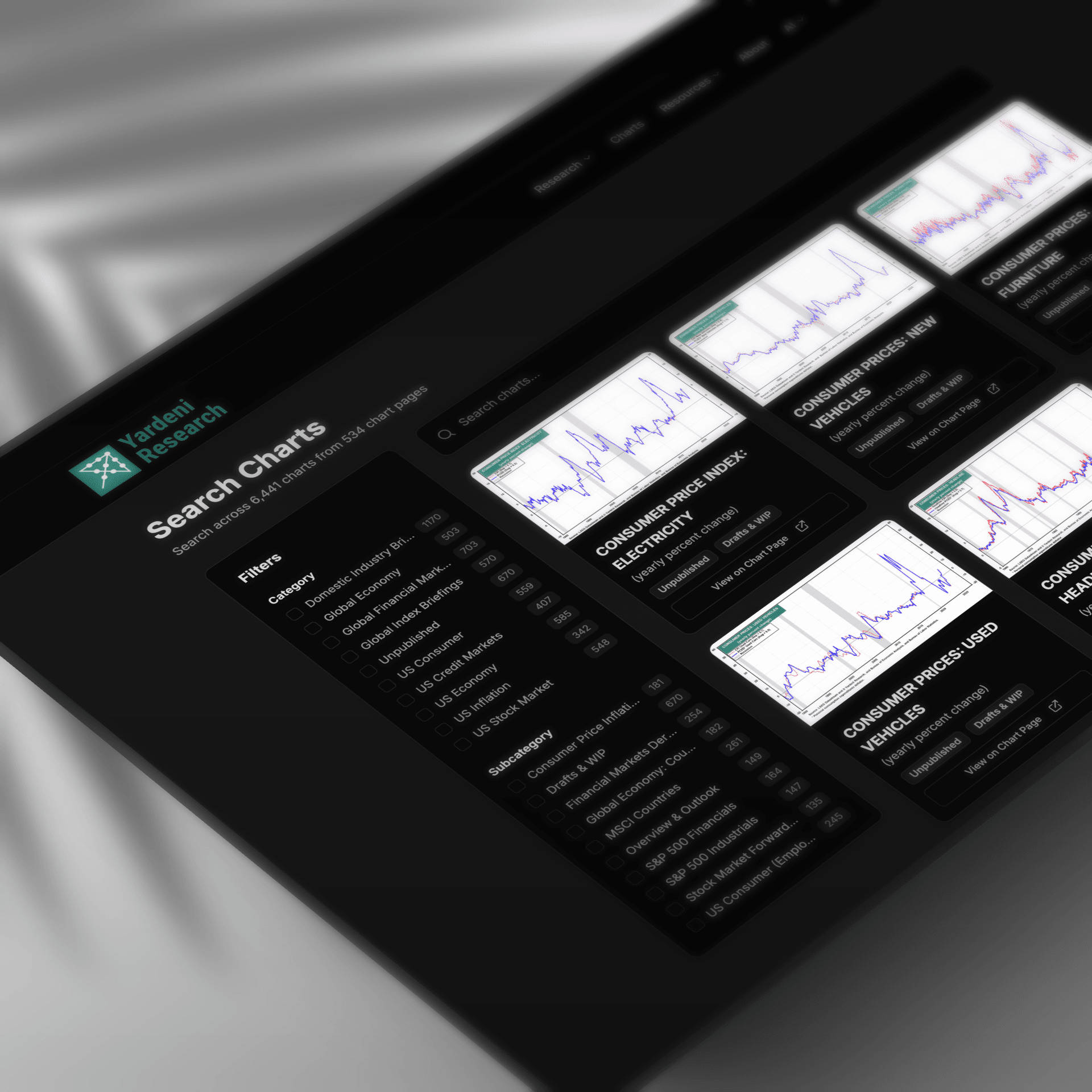
Find Any Chart in Seconds
Search across 7,680+ real-time charts with instant visual previews
INTEL: FORWARD OPERATING EARNINGS PER SHARE
ORACLE: FORWARD OPERATING EARNINGS PER SHARE
NIKE: FORWARD PROFIT MARGIN
S&P 500 TRANSACTION & PAYMENT PROCESSING SERVICES: FORWARD P/E*
Sample charts from our collection of 7,680+ visualizations
Tools
Research Tools
Interactive dashboards for tracking economic conditions and market trends
Beige Book Monitor
Fed economic conditions across 12 districts with traffic-light signals.
FOMC Policy Meter
Dovish-to-hawkish policy stance tracker across FOMC meetings.
FOMC Minutes Monitor
Hawk/dove signal extraction across 10 economic themes.
FOMC SEP Monitor
Fed projections and dot plot distributions across meetings.
FOMC Statements
Every FOMC policy statement since 1997 — full text, rates, and voting records.
Private Credit Monitor
Auto-updating chronology of the private credit liquidity crisis.
Release Calendar
Major publications from the Fed, ECB, IMF, and 12 global institutions.
Try Yardeni Research free for four weeks.
Full access to everything we publish. No credit card, no obligation.