
Independent Financial Research & Analysis
Daily briefings, 7,700+ real-time charts, and macro insights from Dr. Ed Yardeni and his research team.

Research
Latest Research
Recent insights from our research team
On BOJ & ECB Decisions Ahead, European Stocks & Britain’s New Prime Minister
The central banks of Japan and Europe will make decisions on interest-rate policy this week. … William says this is no time for the BOJ to pause its tightening as expected. The stakes are too high. … The ECB likewise is expected to pause. Its ability to focus solely on inflation is compromised by the debt problems of some countries, which are driving up bond yields and doing some of the ECB’s tightening work for it. … Toby observes that European stocks may have been overly discounted amid the debt problems, as the earnings outlook remains good. … Britain’s debt markets seem confident that PM Andy Burnham is no Liz Truss. Now he has to prove it.
Is AI Useless?
I. AI's Toxic Financial Trifecta Recent AI jitters have been fueled by a potentially toxic trifecta of financial constraints: elevated borrowing costs, uncertain investment returns, and concerns about whether sufficient capital exists to finance everyone's ambitious AI spending plans. Consider the following: (1) Elevated borrowing costs. The 10-year Treasury yield is hovering near the upper end of its "old normal" range of 4.0%-5.0% (chart). That puts it at the highest level since 2007. Overall, credit spreads (the extra yield paid over equivalent US Treasuries, such as the 10-year note) have not blown out uniformly across the board. Instead, the market has bifurcated sharply between the pristine balance sheets of mega-cap tech companies and the leveraged balance sheets of pure-play infrastructure/data center borrowers. Yields on AI debt have not broadly surged relative to Treasuries for the dominant Big Tech issuers, whose balance sheets continue to be treated virtually like "proxy sovereigns." However, the credit market is increasingly imposing credit discipline, demanding significantly higher risk premiums and spreads from the leveraged second- and third-tier infrastructure borrowers that are building out the physical plumbing of AI. Increased concerns about the credit quality of AI borrowers have been reflected in widening credit default spreads (chart). (2) Uncertain returns. Gartner estimates that AI data center operators must generate $8.5 trillion in cumulative revenues through 2030 to cover their investments and associated financing costs and still achieve a 12% return on invested capital. Yet Gartner projects no more than $3.6 trillion in attributable AI revenues over that period. In our view, if the numbers don't add up, the pace of the AI buildout will slow. That wouldn’t be a calamity. (3) Increasingly constrained capital. Meta's Q3 earnings report intensified concerns about capital availability. Despite strong revenue growth, the company reported negative free cash flow for the first time since 2012 and announced new non-voting shares to facilitate fundraising, warning of an "increasingly difficult fundraising environment." Today, Meta unveiled plans to raise up to $95 billion through equity offerings. Meanwhile, Broadcom CEO Hock Tan identified capital as potentially the biggest constraint on AI development. BlackRock CEO Larry Fink described competition for capital as the fiercest of his career, while Nvidia CEO Jensen Huang observed that neocloud demand is "off the charts," but capital is scarce. Today, Elon Musk warned that more than 200 specialized AI cloud providers (i.e., neoclouds) are headed for a wave of "guppy-level death and consolidation." Musk stated that debt markets have "almost entirely shut off access to money for any company that doesn't have substantial revenue independent of AI data centers." In recent weeks, the neocloud providers’ stock prices have tumbled (chart). On balance, hyperscalers’ stock prices have held up relatively well (chart). II. Will AI Pay Off? Demand for compute nevertheless remains extraordinary. Global spending on cloud infrastructure services surged 43% y/y to $143 billion in Q2, its fastest growth in eight years. But how sustainable is that demand growth? Ultimately, the marginal economic benefits derived from AI must justify the marginal cost of supplying the necessary compute. We believe AI is already generating tangible economic benefits, even if they have yet to become clearly visible in aggregate macroeconomic statistics. Consider the following: (1) Anthropic's S-1. Anthropic’s IPO filing today offered five revealing takeaways: First, revenues soared from $1.2 billion in H1-2025 to $16.3 billion in H1-2026. Second, operating losses narrowed from $2.1 billion to $693 million, with Q2 marking the company's first quarterly operating profit of $974 million. Third, revenue per dollar of compute expense surged 5.2-fold to $2.08 between Q1-2025 and Q2-2026. Fourth, Anthropic held $131.7 billion in cash and short-term investments as of June, alongside $3.9 billion in H1 operating cash flow. Fifth, its enterprise footprint expanded rapidly, with more than 11,900 customers spending at least $100,000 annually as of September, up from roughly 950 a year earlier. (2) Corporate America's emerging AI payoffs. An August Janus Henderson study of 109 companies found that 69% reported some margin improvement associated with productivity gains and AI-related cost reductions. Among the examples cited, Shell reported $400 million in annual savings and a 45% reduction in unplanned downtime; Freeport-McMoRan increased mill throughput 10% while cutting unit costs by up to 15%; inventories at one Hitachi facility fell 50% and lead times shortened by 77%; and IBM reported $4.5 billion in AI-related savings in 2025. Last Thursday, Barclays announced plans to eliminate approximately 5,000 jobs, or 5% of its workforce, as AI and broader technological modernization improve efficiency. PayPal is targeting $1.5 billion in annualized savings, partly through AI adoption. (3) Corporate profit margins. Corporate America is becoming more profitable. The forward profit margin of the S&P 500 excluding its Information Technology sector has been climbing this year, reaching 12.9% in October (chart). Excluding just the Semiconductors industry, the forward profit margin rose to a record 14.4%. The forward profit margin in Semiconductors rose to a record 51.8% in the week of October 23. But most of the industry’s margin expansion since 2024 is attributable to capacity constraints pushing prices higher. A closer look reveals encouraging trends in industries where AI applications could be particularly beneficial. Forward profit margins have expanded in numerous financial industries where AI offers significant opportunities for automation (chart). Health Care stands to benefit from AI applications that can streamline clinical workflows and administrative processes (chart). (4) Bottom line. We aren't yet seeing significant AI-driven profit margin expansion across the economy, but anecdotal evidence of AI-related productivity gains is mounting. We expect AI adoption to become increasingly widespread across industries, eventually delivering substantial productivity growth and boosting corporate profit margins. AI's economic payoff may not yet be obvious in aggregate statistics, but that doesn't mean it isn't already materializing.
Possible Bad News & Good Buying Opportunities Ahead
When we lowered S&P 500 year-end target a month ago, it had nothing to do with the market’s fundamental underpinnings. Our concerns remain valuation related in light of rising uncertainties in the investment backdrop. But don’t be tricked by scary surprises that send stocks southward; they could be attractive buying opportunities, say Ed and Elias, given the robust economic growth and corporate earnings we continue to expect. Today, they explain why prospective frights from four directions—geopolitical, US political, the Fed, and AI—could turn out to be opportunities in disguise.
Archive
Our Research Library
19 years of daily research, charts, and analysis
Topics
QuickTakes Topics
Timely commentary covering the most important market themes
Charts
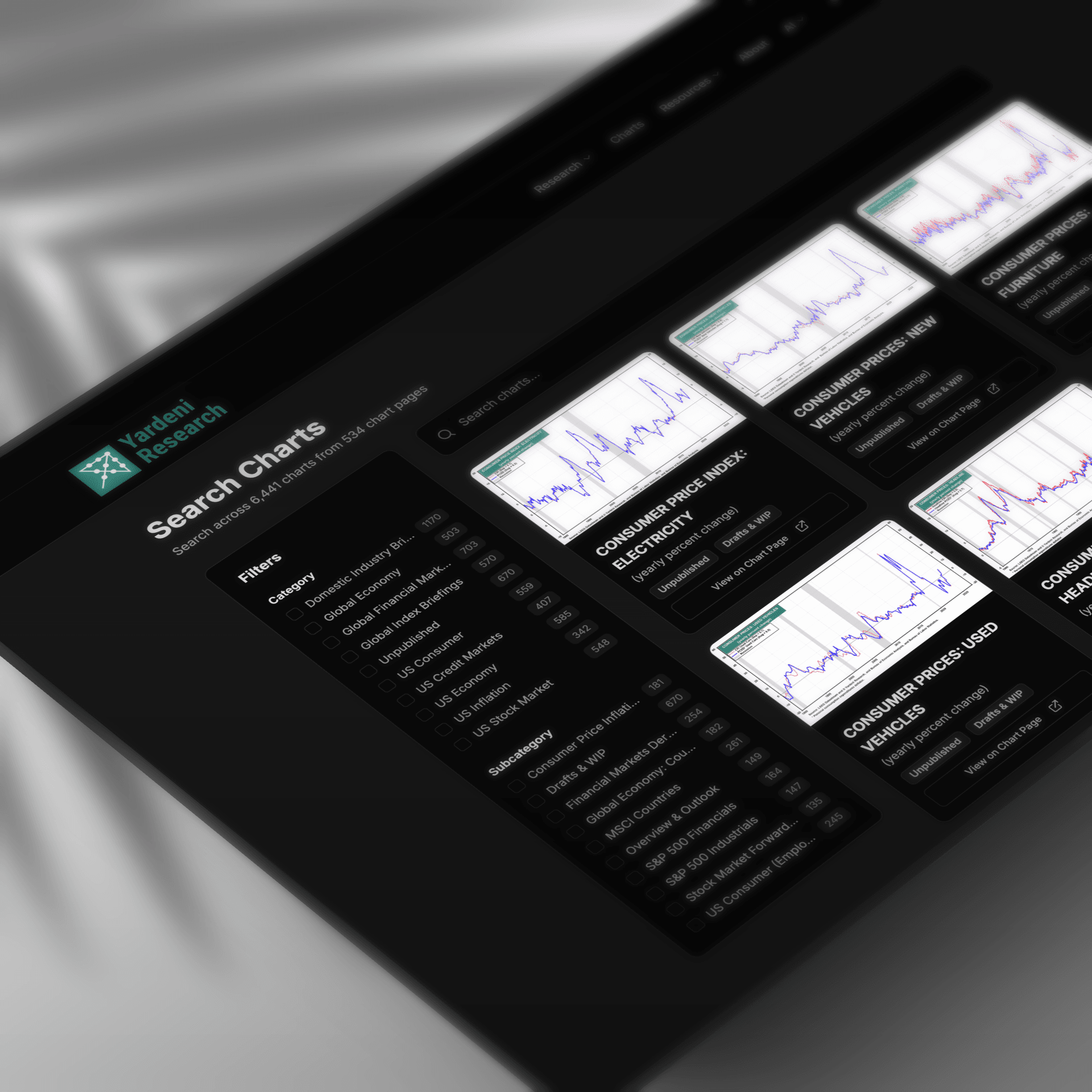
Find Any Chart in Seconds
Search across 7,760+ real-time charts with instant visual previews
PHILIP MORRIS INTERNATIONAL: PRICE, FORWARD EARNINGS & VALUATION
COSTCO WHOLESALE: FORWARD PROFIT MARGIN
COSTCO WHOLESALE: FORWARD P/E
JAPAN CENTRAL GOVERNMENT BUDGET BALANCE AS A PERCENT OF NOMINAL GDP
Sample charts from our collection of 7,760+ visualizations
Tools
Research Tools
Interactive dashboards for tracking economic conditions and market trends
Beige Book Monitor
Fed economic conditions across 12 districts with traffic-light signals.
FOMC Policy Meter
Dovish-to-hawkish policy stance tracker across FOMC meetings.
FOMC Minutes Monitor
Hawk/dove signal extraction across 10 economic themes.
FOMC SEP Monitor
Fed projections and dot plot distributions across meetings.
FOMC Statements
Every FOMC policy statement since 1997 — full text, rates, and voting records.
Private Credit Monitor
Auto-updating chronology of the private credit liquidity crisis.
Release Calendar
Major publications from the Fed, ECB, IMF, and 12 global institutions.
Try Yardeni Research free for four weeks.
Full access to everything we publish. No credit card, no obligation.